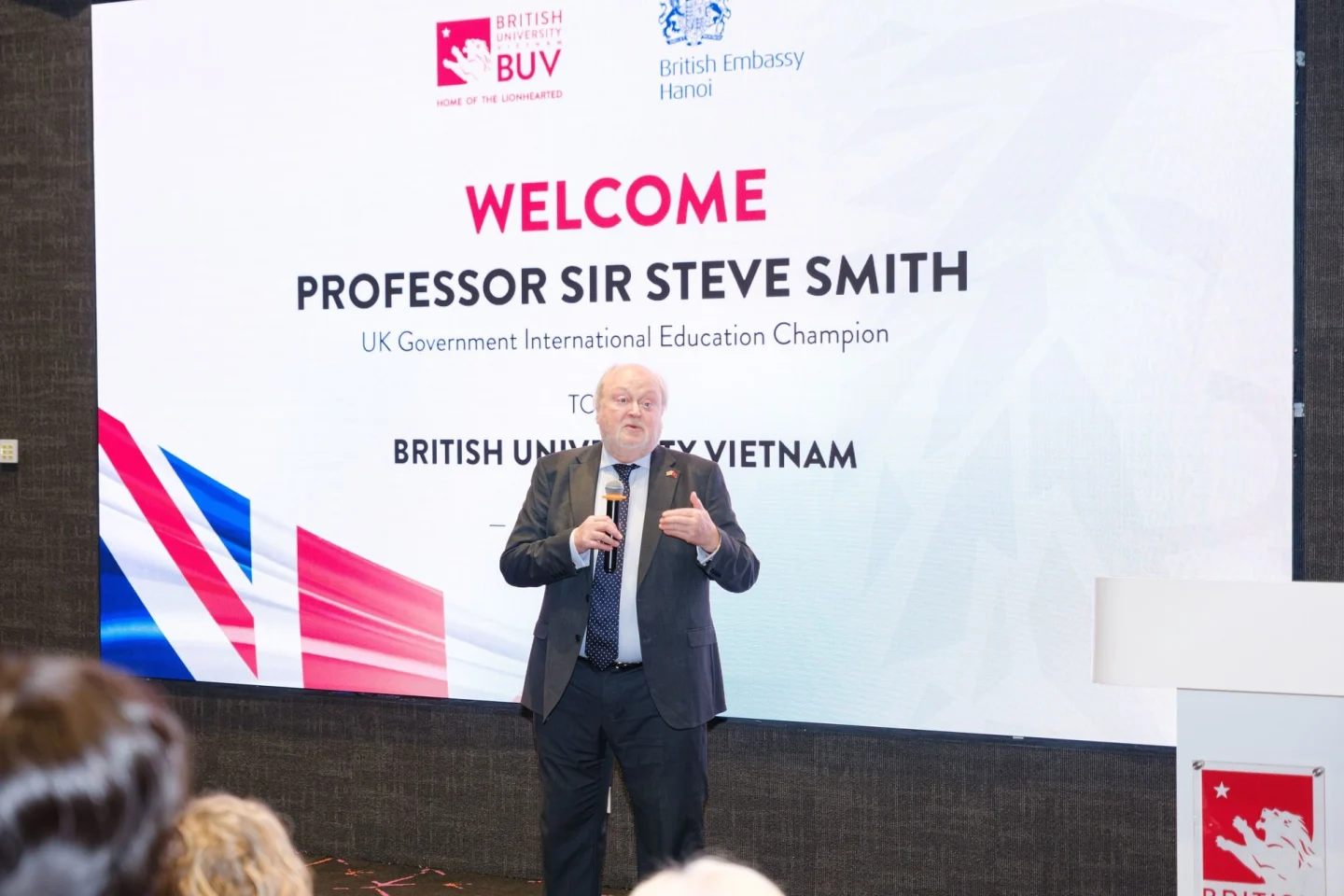
UK Government International Education Champion: “BUV is doing an outstanding job of promoting the highest quality education at university level”
On 7 October, Professor Sir Steve Smith, the UK’s International Education Champion, visited British University Vietnam (BUV) alongside senior representatives from Manchester Metropolitan University (Manchester Met) and the University of London (UoL), as part of their visit to Vietnam for the International Education Conference and Exhibition organised by Vietnam’s Ministry of Education and Training.
Our website uses cookies to enhance your user experience and improve the effectiveness of our marketing activities. By clicking “Accept” or closing this window to continue browsing, you consent to our use of all cookies. If you do not agree to all cookies, please select “Manage cookies”. Learn more about our Privacy Policy and Cookie Policy for full details.
The delegation was welcomed by Professor Rick Bennett, Deputy Vice-Chancellor and Vice-President of BUV, together with members of the University’s senior leadership and Heads of School.
Joining Professor Sir Steve Smith were Professor Jennifer Watling, Pro-Vice-Chancellor International at Manchester Metropolitan University; Mr Ian Jones, Head of International Partnerships at Manchester Metropolitan University; and Professor Mary Stiasny, Pro Vice-Chancellor Emerita at the University of London.
During the visit, the delegation exchanged perspectives on transnational education and the role of high-quality international partnerships in widening access to UK education while maintaining academic quality, relevance and positive outcomes for students.
Professor Sir Steve Smith also met with the first cohort of students studying Manchester Metropolitan University programmes at BUV in 2026. Speaking directly to the students, he reflected on the value of UK transnational education, the opportunities it creates for students to access high-quality international education in their home country, and BUV’s role in advancing this ambition in Vietnam.
Below are his remarks to the students in full.
“I was born into a family in England where no one had been to university. No one. Not one person. I wasn't very well as a child, and I was in hospital a lot. My mum and dad, who had never known anyone to go to university, went to the school to see my teacher. He was a very nasty person, and he told them there was no way I would go to university because I wasn't clever enough. What they should do, he said, was get me a job sweeping the floor of the local shoe factory, the Norfolk shoe factory in Norwich.
This upset my mum and dad very seriously, and they didn't know what to do. That night my dad was crying. He said, "We thought you were quite clever. We thought you could go to university."
Well, I did, and I had a pretty interesting career.
Exactly 15 years ago, my dad died. And this is absolutely true. He was lying on his deathbed and he said, "I want to be buried in this particular church. But you know that teacher who told me you'd never go to university? He's buried there. Do not let me be buried near him, because I will spend the rest of eternity trying to get to him, to tell him what I think of him."
The point of all that is that I belong to a generation, and there are a lot of people in the UK and a lot of people here, who didn't know whether they could go to university, or whether they were good enough. But what happens when you go to university is that it turns a light on: the light of knowledge, the light of understanding, the light of inquiry, to think about the world.
I talked to my colleague Richard the other day. I have met 18 world leaders, and I never thought, as a child, that I would. If someone had said to me at 18, "You'll do this, you'll do that, you'll meet these people," I would never have thought it possible. Never. So the first thing I want to say is that you never know where education is going to take you. It will transform your life. Through your life, it will give you a set of tools and equipment to deal with a very rapidly changing world, and I'll come back to that in my last comments.
The second thing to say is that I have now done over 1,600 meetings for the UK government, over 500 of them abroad, and we talk to many world leaders about their education systems. One thing I can honestly say to you, hand on my heart, is that the UK's education system, from schools to colleges, education technology and universities, is as good as any in the world.
When our Prime Minister goes to another country, quite often the aim is to secure trade deals or defence deals. But in every country our Prime Minister visits, what that country wants from the UK is UK education: schools, colleges, universities. They want the ability to provide education for their citizens at the highest quality.
So my job, in one sense, is quite easy. My job is to meet governments around the world and remove the barriers to education of UK quality in their country. And it is a genuine pleasure to be here at BUV, because BUV is doing an outstanding job in this country of promoting the highest quality education at university level.
Now, you are very fortunate to be studying for Manchester Metropolitan University degrees. Manchester Metropolitan is an outstanding, strong institution. Its head, whom I know very well, is Professor Malcolm Press, who has also led Universities UK, representing all British universities to the British Government. He is very, very highly regarded. So I can assure you, without any hint of concern, that the quality of the education you will get from Manchester Metropolitan University degrees is very high indeed.
When I looked at my sheet of the 41 engagements I would be doing on this trip, the fact that this one was BUV and Manchester Metropolitan University made me relax, because both are high quality, and I knew I was coming somewhere the quality was absolutely unmistakable.
So you are working with a really strong British university. That university is checked for its quality by our government body, the Office for Students, and here by another British body, the Quality Assurance Agency. We are the only country in the world that does this. So we know that the quality of the provision you will get here in Hanoi, in Vietnam, is very, very close. It won't be identical, because courses will be slightly different, but it is the same quality of provision as you would get studying at the university in Manchester. One thing you should know for certain is that the quality of the education you are getting with Manchester Metropolitan is outstandingly strong. So good luck with that.
The third thing I want to say, and I'll end with this, is that a university education teaches you things, but most importantly it teaches you how to think. In Britain we have the phrase that you go to university to "read for a degree". That may have changed a bit with the way people access knowledge, but the idea is that you read to understand the subject, because what matters is not simply what the world looks like today. It is not enough to teach you the current knowledge in your degree subjects. You have to be taught to be intellectually agile, to think about how the world is going to change. What a high-quality degree does is shape how you think in the future.
I am an international relations academic, and I was president of the world body in my field. A few years ago I was in the Houses of Parliament and a BBC journalist came up to me. I didn't remember that I had taught him, but I had. He said, "I always remember your lecture on psychological aspects of decision making." I couldn't remember it. But the point is that, 30 years later, in his job, something we discussed triggered for him how he, as a BBC journalist, should deal with politicians. So it is not just the content. What you are really going to get is an understanding of how to think, how to process and how to interpret the world as it changes.
I have been asked to give you two tips. Why you should believe me, I don't know, but here they are, quickly.
Number one: be aware of friendships and trust. The most important question in my job, working with governments around the world, is whether other governments trust us. I am on WhatsApp with several ministers around the world, and if there is a problem, they WhatsApp me and ask me to sort it out. The big thing I have learned in my career is the importance of personal relationships and trust. Work with people you trust, and trust people until they give you a reason not to. Trust is an incredibly important commodity, and I think it will matter more in the future.
Secondly, please realise that your education is all about being mentally agile. Don't be a slave to a particular view. Be adaptable, and realise the world is changing. The techniques you will learn from a Manchester Metropolitan University degree will enable you to interpret that world, and not treat the world simply as it was.
Where I used to be, at Exeter, we taught medicine, and there are two ways of teaching it. One is to start with the body: you show a vein, you show a brain, and you work that way. The modern way is to start with problems. They start with what a patient presents. Someone comes in with a pain in the elbow: how do you find out what that is? The point is that it is not the factual knowledge so much that matters, it is the approach. So what I would say to all of you is to understand that you are getting a series of intellectual techniques that will enable you to interpret the world as it changes.
When I was 18, the world was very different, and it is changing at pace. There is a famous phrase: we overestimate the amount of change in a day and underestimate the amount of change in a year. Things happen very quickly. What matters is the knowledge you have, the people you work with and the people you trust, and, crucially, the techniques you have in your head for interpreting that world.
So I will finish simply by saying congratulations on getting into these programmes here at Manchester Met. Please feel genuinely confident about the quality of BUV and Manchester Metropolitan University. I hope you have a tremendous time studying here, and I look forward to hearing reports from the Manchester Met team and the BUV team on how you all do.