Redefining the Capability Model of a Valuable Graduate
For decades, a university degree and expertise in a chosen field have been seen as the foundations of a successful career. But as artificial intelligence reshapes the way we work and the skills employers value, is this definition of a successful graduate still enough?
Our website uses cookies to enhance your user experience and improve the effectiveness of our marketing activities. By clicking “Accept” or closing this window to continue browsing, you consent to our use of all cookies. If you do not agree to all cookies, please select “Manage cookies”. Learn more about our Privacy Policy and Cookie Policy for full details.
At the Digital Higher Education & Internationalisation session of the International Education Conference and Exhibition (IECEE), organised by Vietnam’s Ministry of Education and Training, Paul Julian Bennett, Chief Marketing Officer of British University Vietnam (BUV), explored this question through a fresh perspective on graduate capabilities.
Drawing on insights from the Vietnam Employability Report 2026 and the changing relationship between technology and human skills, he proposed a new way of thinking about what makes a graduate valuable, and how higher education can prepare students to thrive in an increasingly digital and interconnected world.
Below is the full text of Paul Bennett’s speech.
---
Good morning. If I asked you to draw a valuable graduate, what would you draw?
Most of you would give me a list: skills, credentials, experiences. A list tells us what a graduate needs. It doesn't tell us how those capabilities fit together, or which matter most as the world changes.
So today, I want to move from the list to the shape, and ask one simple question: what should a valuable graduate look like today?
Because a list tells you what a graduate has. A shape tells you what a graduate can become.
Let me start with a story from banking.
In the late 1970s and 1980s, banks feared that ATMs would empty out their branches. A machine could now dispense cash, accept cash deposits, take cheque deposits, share account balances and make transfers, faster, more cheaply and more accurately than any person, and at any hour of the day.
But economist James Bessen found something surprising. Because ATMs cut the cost of running a branch, banks opened more branches, not fewer. Even as ATM numbers rose rapidly, teller jobs did not decline.
What changed was the job itself. As machines took over those routine transactions, tellers moved towards what machines could not do: understanding customers, building relationships and earning trust. The teller became the bank adviser. Technology did not replace people; machines took the routine, and people brought the human.
More than four decades later, we face a similar shift. AI already sits on our students' laptops every day, producing, analysing and executing at speeds unimaginable when the first ATM appeared, and evolving so fast that no one can say what it will do in five or ten years.
But some things are fundamental. Our ability to build relationships, establish trust and work together has always been how we create value. It was the heart of the teller's new role, and I believe it will remain essential in the age of AI.
So for higher education, the question is this: as AI takes on the tasks graduates have traditionally started their careers performing, what capabilities will let them create value in a technology-driven workplace?
The ATM gives us our first clue: the machine took over the counting, but it never took over the trust.
The European Commission's competence framework offers a useful test: capability matters when people can keep creating value in unfamiliar situations, not simply perform tasks they were prepared for.
We tested that idea against the graduate labour market. This year, British University Vietnam partnered with Decision Lab on the Vietnam Employability Report: Beware the Gap: Are graduates set up for success in a world of new possibilities?, which we launched just yesterday. We asked the employers who hire graduates from every university two questions: what do you expect from a fresh graduate, and what do you actually get?
On expectations, more than 90% of employers told us their expectations for digital and AI capability have risen over the past two to three years. Yet technology was not the whole story. On the left are the signals employers weigh before hiring. Those highlighted in blue are human skills: attitude and cultural fit, soft skills, interview performance and internship experience. And highlighted in red, an international or study-abroad degree was picked as most important more often than any other signal.
On the right is what happens after hiring. Digital literacyis the only area where graduates are already ahead of employer expectations, by three percentage points.
The challenge lies beyond literacy. 36% of employers already expect graduates to apply AI to function-specific problems. As one HR manager told us, using AI is becoming as normal as using Word or Excel; what matters is whether you know enough to check what it gives you.
Just as the teller's value shifted from processing transactions to building trust, the real question is whether graduates can use technology with judgement, apply it in a real context, and understand the human consequences of what they produce.
This is where the gap becomes clear. The areas highlighted in green are all human skills. The largest gaps are in time management, at 26 points, and problem-solving, at 23, with shortfalls in communication and adaptability: the capabilities that surface when work is time-bound, ambiguous and shared with others.
And as work increasingly crosses organisational, cultural and national boundaries, graduates also need a global perspective to operate there.
The gap is not in the technology. It is in the human skills that make technology worth having.
Digital, human and global: these three dimensions are also reflected in Vietnam's own policy direction.
Last year, the Politburo issued Resolution 71 on breakthroughs in education and training. On digital capability, it calls for stronger digital and AI competency standards for learners and teaching staff at every level. On human skills, it calls for a new generation of Vietnamese people equipped with patriotism and national pride, alongside sufficient mettle, intellect, capacity, qualifications and health. And on the global dimension, it calls for educating Vietnamese citizens as global citizens.
Expectations of education are moving beyond the qualification alone, towards graduates who can contribute in a digital, interconnected economy.
Employers and the nation are pointing in the same direction: from qualifications to capabilities.
So if expectations have changed, how should the shape of the graduate change with them?
For a long time, we described the graduate as I-shaped: depth in one specialism, a stable foundation for a career. Many of our parents grew up believing one skill could carry them through a working life.
As work became more interconnected, depth alone was no longer enough. The T-shape added broad knowledge across the top: the ability to connect specialist knowledge with other disciplines, teams and contexts.
Today, that model is being tested again. AI is expanding what technology can do, and globalisation is expanding the contexts in which graduates must operate. That calls for a new shape.
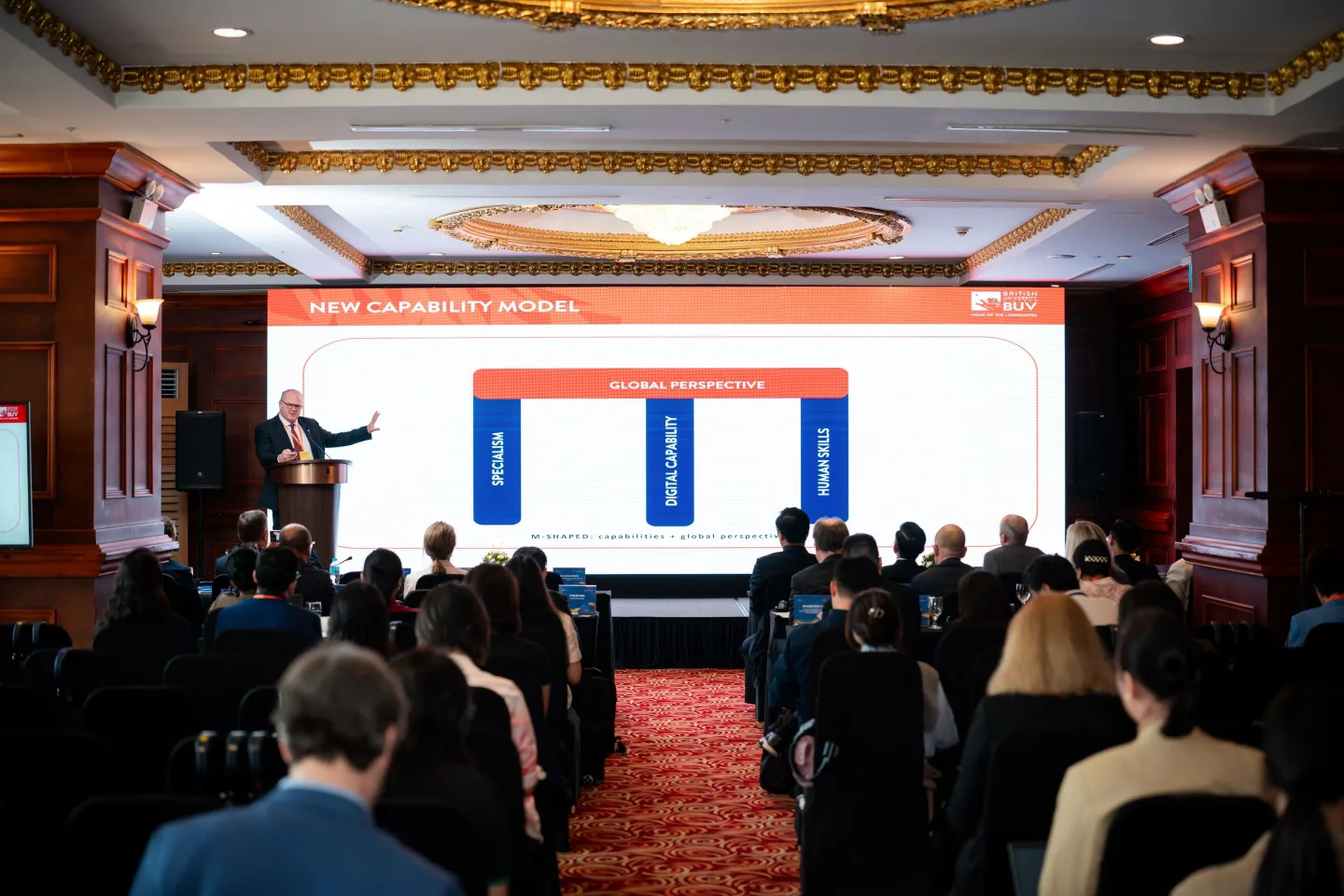
At the foundation is still the specialism that anchors a career, whether marketing, accounting, game development or another discipline, verified through a degree. But as our research shows, credentials open the door; they rarely decide the outcome. The difference today lies in what graduates build around that specialism.
Alongside it, under the same bar of broad knowledge, stand two further pillars: digital capability and human skills. They shape how graduates apply knowledge, adapt to change and work with both technology and people.
And all of it sits inside one circle: a global perspective, which holds the pillars together and allows graduates to apply their capabilities across cultures, markets and contexts.
This M-shaped model allows our graduates to create value beyond a domestic setting, and it aligns with Resolution 71's direction towards developing global citizens.
The I-shape was built for a stable job. The T-shape for a connected one. The M-shape is built for a world that will not stand still.
At BUV, we are putting this model into practice through the way we design the student experience.
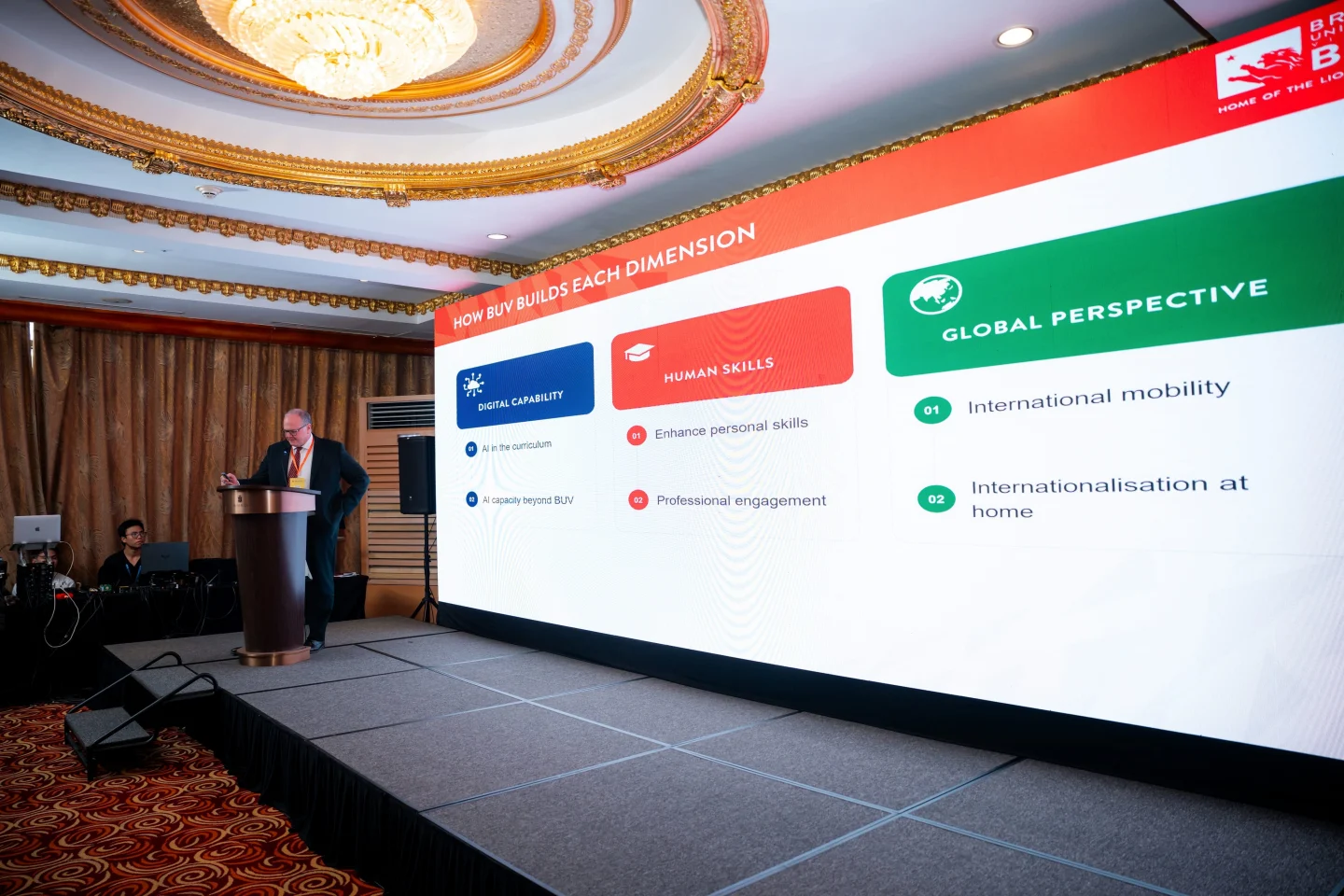
On digital capability, we move students from familiarity to purposeful application. They work with AI-enabled platforms such as Codio and Imagine Explainer, applying technology directly to programming, visualisation and project-based learning.
BUV has also developed the AI Assessment Scale, a five-level framework for the use of AI in assessment, now adopted by organisations globally. That work was recognised at EDUtech Asia 2025, where BUV was Vietnam's sole representative in the top nine for the Best AI Innovation Strategy Award in Higher Education.
Beyond our own students, we work with the Ministry of Education and Training and the Hanoi Department of Education and Training to build AI capacity among education leaders, teachers and public-sector professionals. And as the only university in Vietnam in the United Nations University Global AI Network, BUV brings Vietnam's perspective to the global conversation on responsible AI.
On human skills, where employers see the widest gaps, our Personal Skills packages develop exactly those capabilities: time management, problem-solving, communication and adaptability. The individually designed training is already funded and included in tuition at no additional cost.
Those skills must translate into workplace readiness. More than 500 industry partners contribute through internships and recruitment, curriculum development, industry cases and regular conversations about what the market needs. Those insights feed directly into our Professional Skills packages, so our graduates can create value from day one.
On global perspective, we prepare students for opportunities wherever their careers take them. A network of over 80 international university partners across 19 countries lets them learn in different academic, cultural and professional environments.
But a global perspective does not begin at the departure gate. Through what we call "internationalisation at home", with internationally accredited programmes and qualifications, international faculty, international students and global businesses, our students gain that perspective right here in Vietnam.
Three dimensions, one standard: graduates who can do the work, work with people, and work anywhere.
The M-shaped model will inform BUV's next chapter.
Our graduates already leave with a degree supported by three layers of quality assurance: recognised in Vietnam, within the UK academic system to which the qualification belongs, and against international quality benchmarks. That matters, because an international qualification is only as valuable as the credibility it carries across the systems where graduates will study and work.
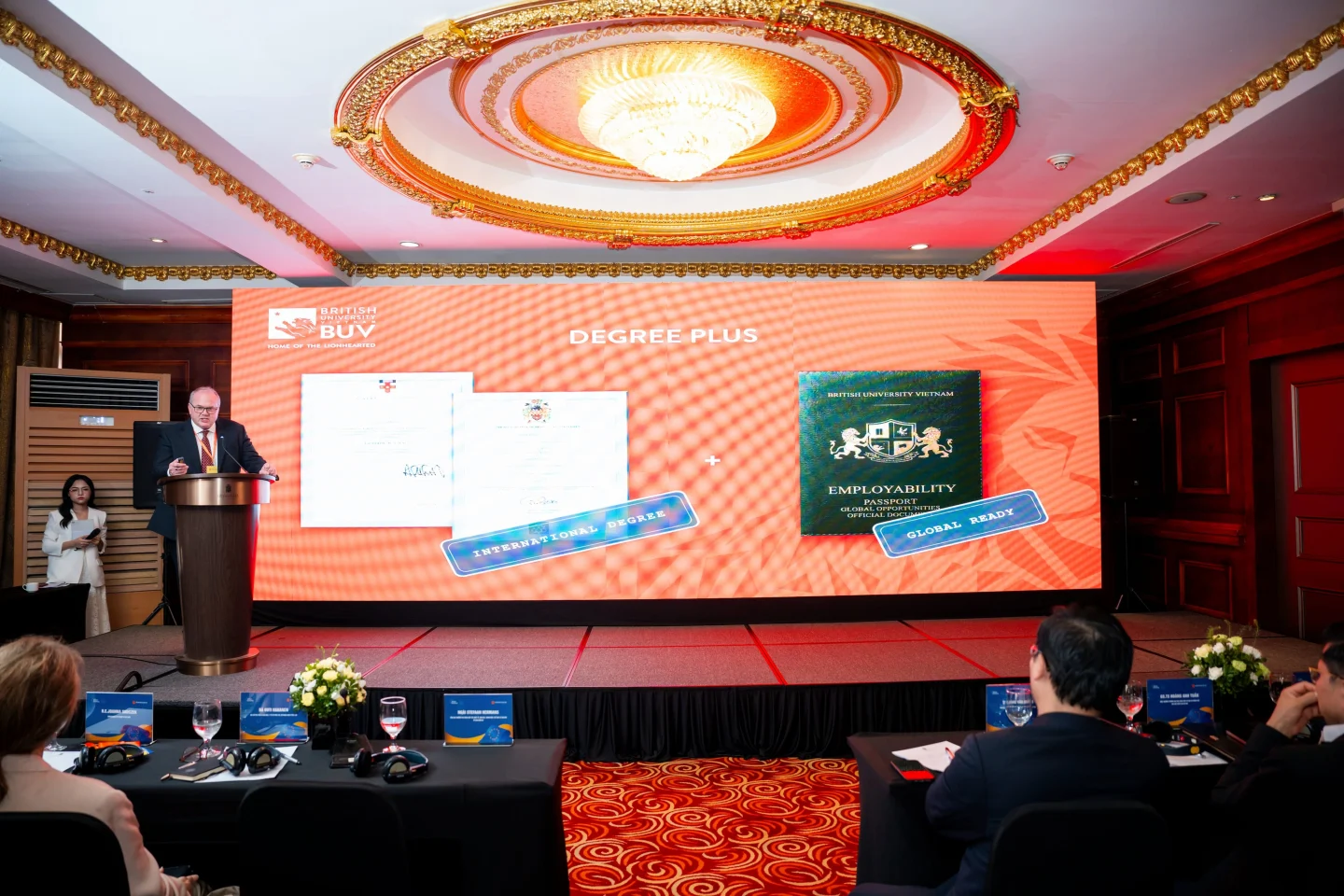
What we are adding now is something a graduate carries alongside that degree. We call it Degree Plus. Built from the professional skills, personal skills and international exposure I have just described, it adds up to a second document: a Global Employability Passport, awarded at graduation right alongside the degree, that marks every BUV graduate as global ready.
So let's go back to the question I opened with. What does a truly valuable graduate look like? An international degree, plus employability credentials that prove it.
The degree says what a graduate knows. The passport proves what they can do.
No university can develop this graduate alone. It takes government, universities and employers working together.
If you work in industry or higher education and share this direction, we invite you to join us in opening new doors for the next generation: to learn, to contribute, and to carry exactly the capabilities a changing world will ask of them.
Forty years ago, the ATM did not replace the bank teller. It created the bank adviser. AI will do the same across every profession in this room.
So let's make sure that every graduate we send into that world is ready to be the adviser, not the machine.