At the International Conference on Educational Cooperation in the Digital Era and Education & EdTech Exhibition (IECEE 2026), hosted by Vietnam’s Ministry of Education and Training on 8 October 2026, Professor Rick Bennett, Deputy Vice-Chancellor and Vice President, British University Vietnam (BUV), proposed a “Degree Plus” approach - a university degree complemented by certified employability capabilities. While reaffirming the value of degrees, he emphasised the shared responsibility of government, universities and employers to bridge the gap between education and the demands of the workplace.
Below is the full text of Professor Rick Bennett’s speech, “Rethinking the Value of a University Degree in the Age of Artificial Intelligence”.
---
"For many decades, the university degree was arguably the most trusted credential we had. It told us something important about the recipient.
The person had studied. The person had been tested. The person had demonstrated knowledge - (differing amounts depending on their grade!)
And for a long time, that was enough.
But, the world has changed around the degree. And it’s changed quickly. Universities have changed too. They are less about theory and debate. And more about practicalities and preparing for work.
Students today increasingly choose degrees with a clear path to employment.
- Computer science.
- AI.
- Data.
- Finance.
- Supply Chain.
- Health Sciences
Professional degrees over humanities degrees.
But – even with more vocational choices, we have to ask a difficult question.
Is the degree still enough? Is what students learn at university going to be relavent for their entire 40 or 50 year career?
I am not so sure it will. So a question for universities is whether they are changing fast enough to keep pace.
Today, there is significant anxiety about how the rapid introduction of AI will take over our working lives. Parents are worried about it, students even more so.
But, we have been here before.
Two hundred years ago, skilled workers in mills in the north of England began breaking into factories at night. To smash the new machines that were replacing their traditional looms. These men became known as ‘Luddites’.
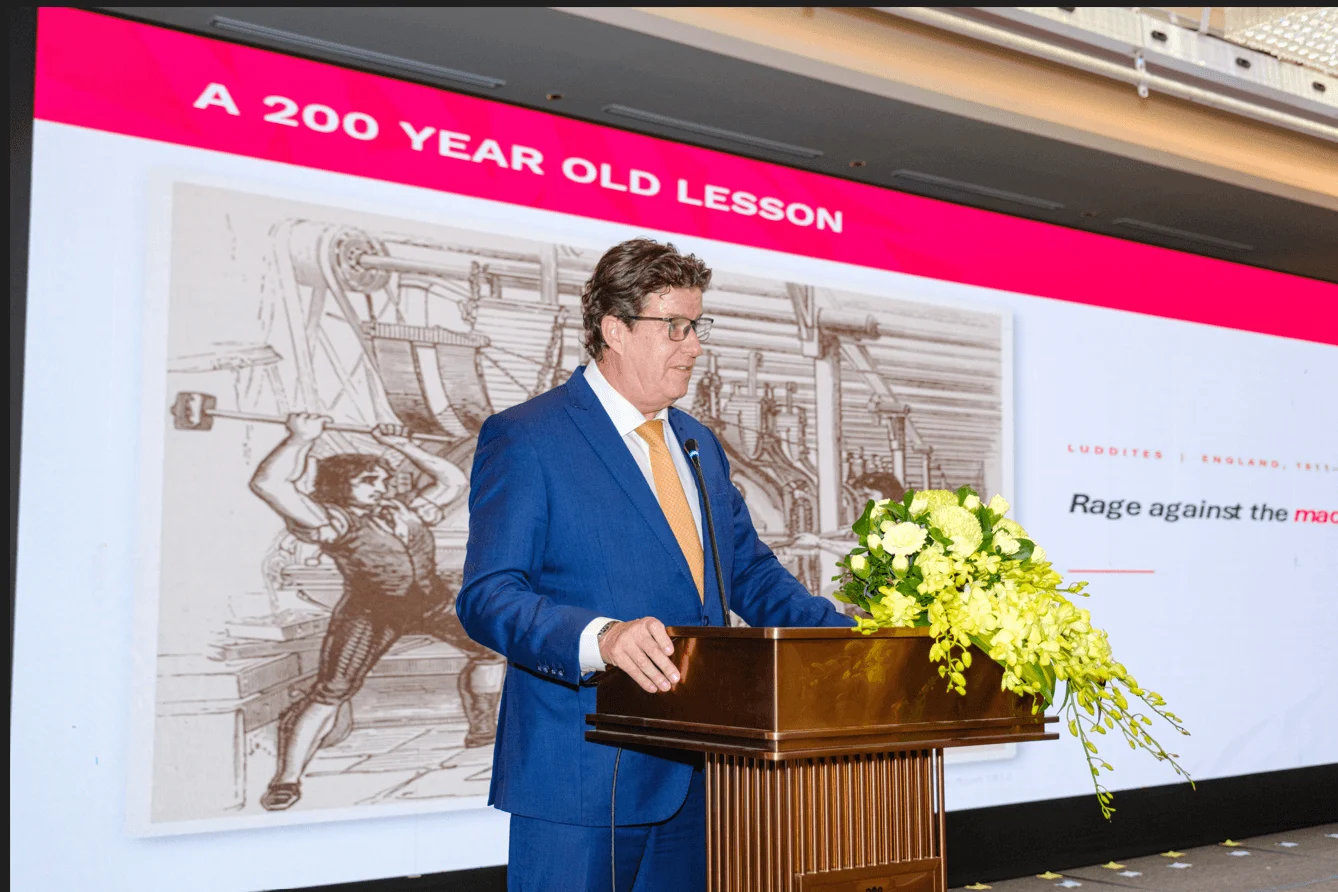
Today, in English, we use that word, rather disparagingly, to describe people who resist technology - or are stuck in the past. But the Luddites weren’t stupid. They were highly skilled and intelligent.
They could see what was coming. They understood that the new machines were going to replace them - and ruin their livelihoods. Their diagnosis was not wrong. Their response was. Because you cannot stop a technological revolution with a hammer.
And, their story matters again today. Because we are witnessing another profound technological change. AI is not somewhere in the future. It is already here. It is already changing work. And many of the tasks our graduates perform in the first years of employment are exactly the ones that AI can - and will - replace.
This creates another challenge for universities. Some are still debating whether AI even belongs in education. But, whilst universities debate, our students are already using it. And often using it very well.
So the question is no longer: Should they use AI? The question is: How? How do universities teach students to use it intelligently? Critically. Creatively. How do universities prepare graduates not only for today’s world … but for the world that is coming next?
To answer that, we should first remind ourselves what a degree actually is. Traditionally, universities took a relatively stable body of knowledge. And they certified that a graduate had mastered it. That graduate then entered a career where much of that knowledge remained valuable for years. Often decades. And … For most of the last century, that model worked well. Because the future changed slowly enough for that knowledge to hold its value.
But new technologies change jobs. They change industries. They change knowledge itself. And increasingly faster than ever. So are universities handing graduates a certificate of the past ... and sending them into a future nobody can predict?
And, if what they learn loses relevance before they finish their careers … Are universities awarding degrees with an expiry date? That question led us to employers.
Over the past 12 months, British University Vietnam has invested significant time and resources talking to them. Across many sectors. And we asked one very simple question. Are new graduates equipped and ready for the workplace? Not just our graduates. Graduates in general. The overwhelming answer was … no. !! Now this matters greatly.
Because Vietnamese parents increasingly want to know something very specific. When my son or daughter graduates ... will they be able to get a good job? So we then asked ourselves … What - and where - is the gap between graduation and being work-ready?
BUV commissioned Decision Lab, an independent market research firm here in Vietnam. They surveyed 375 employers operating in Vietnam. Vietnamese companies and multinationals. Together, they agreed 7 capabilities considered the most important for new graduates today.
They then asked the employers 2 questions:
- How important is each capability for a new graduate?
- How well do the graduates you hire actually perform them?
The chart here shows the responses. And the message is clear. In six of the seven capabilities, new graduates fall below what employers say they need. And those six capabilities have something in common. They are human capabilities.
- Judgement.
- Communication.
- Understanding people.
- Working with people.
- Dealing with ambiguity.
- Knowing what to do when nobody has told you what to do.
But, there is the one exception.
Here, graduates slightly exceed employer expectations. At least that might be some good news?But think about it for a minute. The one area where graduates are performing above expectations ...is the one area most exposed to automation (or replaced by AI). If this is true, there is a big problem. Higher education may be preparing students to compete with the machine. And that is one race graduates probably can’t win.
Remember the Luddites? So what can we do?
First, I want to be clear. I am not arguing against the degree. Quite the opposite. The degree still matters. It remains the trusted proof of quality knowledge. And trust in education quality is of huge importance for Vietnamese parents.
In transnational education (such as BUV), that trust of quality can be verified from three different places.
Locally - In the country where the university operates. (MOET)
Nationally - In the country where the qualification comes from. (QAA)
Internationally – against recognised international standards. (QS, AACSB)
At BUV we call this the Triple Quality Framework. It sets a high bar. And it should do. To assure proof of quality and to maintain trust with parents and students.
So my proposition is very simple. Keep the degree!! But add to it. A degree ... plus a certified employability credential.
A Degree Plus.
And I believe universities can build that “plus” in three ways.
First, bring industry into curriculum design. And I mean design. Not simply guest lectures. Real involvement. Obviously, employers understand what they need... So, let them help universities develop valuable programmes.
Second, certify those capabilities. Give students a record that sits alongside their academic transcript. A record of what they have demonstrated they can actually do. Something visible. Something credible. Something an employer can see, understand and trust.
Third, make international exposure part of preparation for the workplace. Not simply a leisure activity. But, a competitive, educational and experiential necessity. Vietnam’s Resolution 71 calls for education that combines national identity with international integration to develop Vietnamese citizens who can engage globally. That ambition has real consequences for higher education. Because a graduate sitting in Hanoi today may work for a company led from Singapore. London. New York. Or anywhere else. They may never leave Hanoi. But, their workplace is already international. Preparing students only for the domestic market is no longer enough. The workplace has already moved beyond that.
Again, higher education must keep up. And that brings me to my final point.
Because this challenge – The Degree Plus - is bigger than any one university. This belongs at national level … Government sets the national direction. Universities build the capability. And Industry tells us what that capability needs to look like in practice.
So, Employability sits where all three meet. Each stakeholder holds part of the answer. None holds all of it. And Vietnam has already recognised the importance of that relationship. MOET’s Official Letter 2272, specifically provides guidance for cooperation between the State, Universities and Enterprise. Not three parties acting separately … But three parties working together.
The chart I showed you earlier is just one part of a much larger research study. That study was formally released here today as a white paper titled: Vietnam Employability Report ,2026, From Qualifications to Capabilities. It was shared with both Vietnamese and UK education ministers. BUV has began this initiative and intends this to be the first of a regular employability review. But, we need, and we invite, others to join this challenge. Because no university can solve this alone. No employer can solve it alone. And government should not have to solve it alone. The direction has been set. Now we have to build the solution. Together.
- To validate what graduates know.
- To certify what they can do.
- And prepare them for what comes next.
This is a responsibility we must share. It’s our collective duty to achieve this for the future of Vietnam. And that is why the future of higher education should now go ...
Beyond the Degree.
Thank you."